Join the Department of Performing and Media Arts and the Department of Classics for Elemental Readings III: The Matter of Earth, a symposium spanning four days and various locations from Thursday, April 23 through Saturday, April 25, and on Friday, May 1. A performance of BIOphelia will take place on Thursday, April 23, from 3:00 pm to 5:00 pm, in Room 121, Cornell Atkinson Center for Sustainability. The Earth Symposium show will take place on Thursday, April 23, from 5:30 pm to 7:30 pm, in the Black Box Theatre, Schwartz Center for the Performing Arts. See below for a complete list of events, including guest speakers, panel discussions, art exhibitions, workshops, and contributor abstracts. Free and open to the public. First-come, first-served.
“This event presents us with a wonderful opportunity to bring together scholars, artists, and performers from across Cornell, the local community, and beyond who are invested in the environmental arts and humanities,” said Professor Verity Platt, a creator and organizer of this symposium. “We are excited to celebrate Earth Week by looking to the element of earth itself – celebrating that which nourishes us whilst also exploring the many ways in which it has been handled, understood, or exploited over human history.”
Of all the ancient elements, earth holds most affective power. For Pliny the Elder, earth was “the element that is never angry with mankind”: in her capacity as our "mighty parent” or “mother”, Earth is embodied, personified and feminized; she nurtures us during life with all that she produces and receives our bodies in death, “even bearing our monuments and epitaphs and … extending our memory against the shortness of time.”
Yet Earth’s generosity also opens her to abuse, whether through violent extraction and pollution or fascist ideologies of “blood and soil.” As the element associated primarily with “matter,” earth provides the materials that make artistic expression possible, especially through the mediums of clay (from which humankind was itself crafted in many mythological traditions), stones, metals, and pigments. In dualist ontologies that denigrate ‘mere matter’ (in contrast to transcendent form, or intellect), terra is all too easily cast as territory, subject to measurement, ownership, conflict, and predation. Earth models and invites the most utopian of projects (co-constitutive visions of symbiosis and sustainability) but is also co-opted into the most dystopian and contested.
Our symposium explores these tensions across diverse periods, cultures, and media. Whilst classical antiquity’s relationship to earth (as mater and matter, as site of both nourishment and burial) plays a key role, contributions come from across the arts, humanities, and sciences, especially as they engage with both indigenous epistemologies and environmental studies.
This symposium is co-sponsored by the Department of Classics, Department of Performing and Media Arts, Society for the Humanities, and Central New York Humanities Corridor.
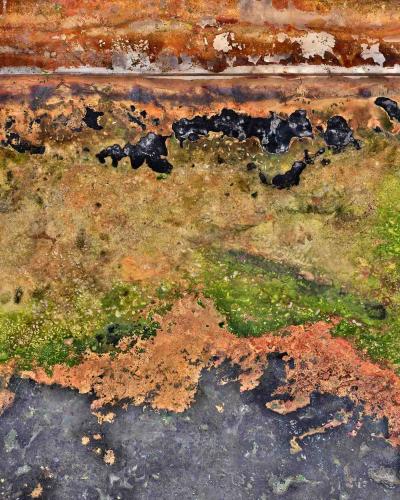
Artwork by Jenifer Wightman, Chester River Mud Painting, 2023
COMPLETE LIST OF EVENTS APRIL 23-APRIL 25
April 23: Day 1
3:00 pm – 5:00 pm, Cornell Atkinson Center for Sustainability, Room 121
-BIOphelia performance
Performed by Amanda Vialva, New York-based actor, dancer, and singer.
Design by Adam Washiyama Shulman, multidisciplinary ecoscenographer and theatrical designer.
Assistant Directing by Neah Lakin, JHU Ph.D. candidate, New Swan associate
Script and Staging by PMA Senior Lecturer Theo Black
“Bridging PMA’s Fall 24 interdisciplinary symposium of BIOphelia into a touring show allows this work to evolve in exciting ways. Its premiere at New Swan Shakespeare Center in L.A. and recent performance at The Shakespeare Association of America Conference in Denver allowed audiences familiar with Shakespeare’s Hamlet to see a new take. We are honored to have it selected for the World Shakespeare Congress in Verona this summer, and then to continue its journey as part of NYC’s Broadway Climate Summit.”
Hamlet tells us that the purpose of playing is to hold "a mirror up to Nature.” Yet Ophelia’s ecological affinity is often overlooked. What if Ophelia's herbs and flowers were given a central place on stage? What if Ophelia’s seeded potential were to be cultivated, enhanced, and empowered in our shared era of ecological crisis? In this world premiere performance, actor Amanda Vialva revives Ophelia’s journey, to evolve Shakespeare’s story beyond the binary of Hamlet’s existential question (you know the one) and look at how we may adapt as part of nature, and better learn to inter-be. Read more about BIOphelia.
5:30 pm – 7:30 pm, Black Box Theatre, Schwartz Center for the Performing Arts
-Introduction
-Earth Symposium Show
Performed by the students in PMA 4801 Advanced Acting: Arin Sheehan, Josh Martin, Mark Lee, Alina Lee, Kate Moran, Ava Alvarez, Lasya Vadlamani, Ashley Dorais, Naomi Buckle.
Directed by Theo Black.
7:30 pm: Dinner for visiting speakers
April 24: Day 2
9:00 am – 2:30 pm, Film Forum, Schwartz Center for the Performing Arts
9:00 am – 9:10 am: Welcome address
9:10 am – 10:30 am: Panel 1 (chair and respondent: Amrita Chakraborty)
Jolene Rickard (Cornell): Indigenous Temporal Shifts in Place-Making
Mitchell Herrmann (Yale): Precious Okoyomon: Towards a Natural History
10:30 am – 11:00 am: Coffee
11:00 am – 12:20 pm: Panel 2 (chair and respondent: Athena Kirk)
Nancy Worman (Barnard/Columbia): Stones, Caves, and Girls in the Wild
Victoria Wohl (Toronto): The Beauty of Stones
12:20 pm – 1:00 pm: Lunch
1:00 pm – 2:20 pm: Panel 3 (chair and respondent: Jeremy Schneider)
Alex Purves (UCLA): Earth Time
Chad Córdova (Cornell): Earth and Water: Of the Elemental Interplay in Montaigne
2:30 pm – 3:00 pm: Travel to The Soil Factory
3:00 pm – 6:00 pm, The Soil Factory
3:00 pm: Birthed of Clay and Returned to Soil, a workshop with Taylor Rae of Raeflower Holistics REGISTER HERE
4:00 pm: Japanese Knotweed tea ceremony with Adam Washiyama Shulman and Miyawaki Forest planting
5:00 pm: Opening reception for Earthen Acts, an art exhibition curated by Anna Davidson
6:00 pm – 8:00 pm, The Soil Factory
Shared evening meal
April 25: Day 3
9:00 am – 6:30 pm, Klarman Auditorium, Goldwin Smith Hall
9:00 am – 10:20 am: Panel 4 (chair and respondent: Carolyn Fornoff)
Michael Charles (Cornell): Maps, Models, and Sovereignty: Transforming Spatial Data for Place-Based Decision-Making
Steven Mana‘oakamai Johnson (Cornell): He aliʻi ka ʻāina, he kauā ke kanaka: Genealogical Geographies and Environmental Governance in Hawai'i
10:20 am – 11:00 am: Coffee
11:00 am – 12:20 pm: Panel 5 (chair and respondent: Stephanie Shirilan)
Rebecca Zorach (Northwestern): “Only the tomb for these creatures, or their cradle?”: Fossils and the Animated Earth in Early Modern Europe
Wenyi Qian (Toronto): Crafting Lithic Phytography in Grand Ducal Tuscany
12:20 pm – 1:20 pm: Lunch, History of Art Gallery (Participants only)
1:20 pm – 2:40 pm: Panel 6 (chair and respondent: Ana Howie)
Jessica Rosenberg: Earth, in Deliquescence: Emmerich, Shakespeare, Ovid
Kelly Presutti: The Aesthetics of Terrassement (Earth Moving) in French Ports
2:40 pm – 3:00 pm: Break
3:00 pm – 4:20 pm: Panel 7 (discussant: Verity Platt)
Johannes Lehmann (Cornell) and Pedro X Molina: Unearthing Soil Humus Identity with Scientific Change through Comics”
Christine Elfman (Ithaca College): All solid shapes dissolve in light: Photography and the Desire for Resolution
4:20 pm – 5:00 pm: Tea
5:00 pm – 6:30 pm: Staged Reading of Madeleine George’s Hurricane Diane produced by Cog Dog Theatre Troupe, a Cornell student organization
Meet Diane, a permaculture gardener dripping with butch charm. She's got supernatural abilities owing to her true identity - the Greek god Dionysus - and she's returned to the modern world to gather mortal followers and restore earth to its natural state. Where better to begin than with four housewives in a suburban New Jersey cul-de-sac?
7:00 pm – 9:00 pm, History of Art Gallery
Reception and Dinner (Participants only)
May 1: Day 4
5:00 pm – 10:00 pm, The Soil Factory
- 5:00 pm – 6:00 pm: Earthen Acts Exhibition Closing and Piano Performance by Daniel Shulman
- 6:00 pm – 10:00 pm: Full Moon Potluck
ABSTRACTS (IN ALPHABETICAL ORDER)
Michael Charles (Cornell)
Maps, Models, and Sovereignty: Transforming Spatial Data for Place-Based Decision-Making
As climate change accelerates pressures on land, water, and mineral resources, communities increasingly face decisions under conditions of deep uncertainty. For Indigenous Nations, these decisions must balance intergenerational knowledge and cultural practices with real-time data and transparent interpretation. Curating localized and contextualized spatial information can strengthen Indigenous sovereignty by supporting self-determined governance and enabling communities to anticipate and respond strategically to external interests in land, energy, and mineral resources. Yet many national datasets remain too coarse, fragmented, or difficult to interpret at the spatial scales most relevant to Indigenous lands and governance. This talk highlights efforts to transform existing public datasets and develop spatial modeling frameworks that synthesize new insights, producing locally meaningful tools that support research, teaching, and community conversations. While these projects are developed in collaboration with Indigenous communities, the approaches illustrate broader lessons for place-based decision-making. Examples include geospatial analyses mapping relationships between Tribal lands and mineral development, integrated climate-crop models exploring drought risks and irrigation strategies in the Navajo Nation, spatial models linking land-use decisions to air pollution and public health outcomes, and interactive platforms connecting land dispossession to contemporary food sovereignty indicators. Together, these efforts demonstrate how interdisciplinary approaches to spatial data can complement geographic perspectives on place, governance, and environmental justice.
Chad Córdova (Cornell)
Earth and Water: Of the Elemental Interplay in Montaigne
Michel de Montaigne (1533–92) is increasingly recognized, today, as an untimely counterpart of contemporary concerns, especially in ecological thought and ethics. But if Montaigne is a thinker of earthly life, in this sense, he also had a rare condition, which made the proximity of the earth so great that it became a source of incredible pain, and pleasure. He suffered and perhaps died, that is, from kidney stones. No mere biographical detail, this petrifactive proclivity to e gender tiny rocks in the organs, and the ways in which they were produced, dissolved, and flushed from the body, resonate, across Montaigne’s writings, with a proliferation of geological and manmade stoney structures and their fundamental strife, and interdependence, with modes of flow. Turning to Montaigne’s accounts of travel, illness, fortification, and home invasion in the Travel Journal and the Essays, this talk brings forth this tacit elemental interplay—a quasi-dialectic of earth and water—that undergirds many of the disparate themes that characterize Montaigne’s thought at its most contemporary. In particular, the talk shows how this elemental ontology structures his paradoxical idea that hospitality, rather than immunity or self-preservation, is essential to life.
Christine Elfman (Ithaca College)
All solid shapes dissolve in light: Photography and the Desire for Resolution
How can the photographer invite Earth to represent itself, as Henry Fox Talbot suggested in the Pencil of Nature? How do early ways of understanding the agency of the photographic subject relate to our current relationship to Earth? This talk will consider the balance between intention and chance that creates a living work of art, as opposed to a preconceived or static image reflecting the desire for control or extractive value. Photographic practices that consider the subject as the medium, the medium as the connection between the abstract and concrete, and process as an exercise in integrity will be presented in ecological terms. Even Amaranth considers the ancient myth of Diana and Actaeon through fading amaranth photographs, as the attempt to possess or control earth through her image. All solid shapes dissolve in light presents supposedly solid subjects such as rocks, classical statues, fossils, and plaster cast maternal hands as constantly shifting, albeit at a rate that is difficult for us to perceive. Salt Sand Silver considers how the photograph is like a house, reflecting our desire for stability in ever shifting sands and rising seas. Each of these bodies of work reflect on the medium of photography as both a reflection of our desire for resolution, and the humbling awareness of matter beyond our grasp.
Mitchell Herrmann (Yale)
“Precious Okoyomon: Towards a Natural History”
This paper examines Precious Okoyomon’s recent series of kudzu “gardens,” art installations incorporating living plants, and attempts to theorize the posthumanist vision of history that guides the artist’s practice. Okoyomon (born 1993, Nigerian American) describes “soil memory” as the way “plants remember history,” in particular the racialized impact of colonialism on human and nonhuman life in the Americas. History has typically been considered the exclusive domain of human beings, whereas nature is thought to change but remain bereft of true historicity. Okoyomon, by contrast, emphasizes the ethical autonomy of organisms like kudzu, whose history is not merely an accumulation of events recorded by science but is a narrative of flourishing and suffering– a natural history or Naturgeschichte, to echo Walter Benjamin’s and Theodor Adorno’s earlier theorization of the term.
The conventional denial of nature’s historicity, I argue, is tied to what Michel-Rolph Trouillot describes as the colonial dismissal of “all non-Westerners as fundamentally non-historical.” Both nature and non-industrialized civilizations are seen as mired within a cyclical stasis, or as undergoing change in an aimless manner devoid of meaningful directionality. Any challenge to this hierarchical logic is therefore equally decolonial and ecological. Such a challenge can be witnessed in Okoyomon’s overflowing gardens of kudzu, which celebrate the unexpected resistance this plant has achieved to its own instrumentalization by colonial forces that would remold the Americas into a vast plantation where life is subordinated to the exigencies of profit.
Johannes Lehmann, scientist and Pedro X Molina, artist (Cornell)
Unearthing soil humus identity with scientific change through comics
The notion of humus as a central component of soil has been recently upended in response to fine-scale observations of the molecular composition of soil organic carbon. What exactly has changed and how does that impact our understanding of soil health and how we manage it? This contribution reviews the scientific evidence and introduces graphic novel techniques to investigate the historical ballast of the humus concept as well as its prospects: reimagining humus as functional complexity based on complex system science may provide new ways forward. And resilience as a result of organismal as well as molecular diversity may provide new models for community organization in general. We propose graphic novels as a method of scientific inquiry itself rather than of science communication.
Steven Mana‘oakamai Johnson (Cornell)
He aliʻi ka ʻāina, he kauā ke kanaka: genealogical geographies and environmental governance in Hawai'i
The land is chief, people are its servants. This ʻŌlelo Noʻeau (proverb) speaks to the inherited responsibility for Kanaka Maoli (Native Hawaiians) and kamaʻāina (general term for residents of Hawai'i) to care for the environment. However, colonialism and unfettered capitalism have deeply severed and hindered the possibility of fulfilling this responsibility. Western environmental governance principles that favor sector-based decision-making over culturally centered relationality with the more-than-human continue to exacerbate these issues. In this paper, we highlight two research projects that seek to address these challenges in Kealakekua, Hawaiʻi. Emerging from a lineal descendant-led community planning process, we employed a multicultural methodological approach to share moʻolelo (stories) about how environmental governance augments human-environment relationality. We conducted interviews with community members on two topics: marine protected areas and water quality. Qualitative data were paired with traditional Hawaiian environmental observational techniques. The topics of greatest importance to community members include Indigenous rights, food and water security, and self-determination. These projects aim to support a relational approach to environmental governance based on genealogical geographies.
Kelly Presutti (Cornell)
The Aesthetics of Terrassement (Earth Moving) in French Ports
This talk tracks the transformation of French ports in the second half of the nineteenth century. As France’s imperial ambitions expanded, so did their ships. The country’s coastal infrastructure needed to accommodate a growing fleet and the practice of terrassement, earth moving, was crucial to making space for bigger ships and increased traffic. Steam-powered dredging machines capable of excavating over one thousand square meters of sludge with each pass deepened harbors. But the movement of the sea meant that sediment was continually being redeposited, and ports required constant maintenance. I argue that this work of underseas maintenance registers in surprising places, including in the port paintings of the painter Paul Signac. Signac’s insistence on clarity bears an affinity to the need to clear French waterways, giving us new purchase on the extent to which empire conditioned French aesthetics.
Alex Purves (UCLA)
Earth Time
Various temporalities share associations with the earth, such as geological time, agricultural time, environmental time, or seasonal time. In this paper I try to map out some of the kinds of time that emerge from earth’s elementality (mud time, clod time, dirt time, dust time?). Arguably the slowest of the four elements, earth is “stable, dense, slow, fertile” to borrow from Gaston Bachelard, who prompts us in Water and Dreams to try to come to terms with earth’s “material imagination” through its admixture with water in the form of clay or paste. Earth slows the hands and the body down, but is this a hindrance or help in the crafting of material into form or matter into imagination? In this paper I will chart some examples of the temporality of various patches or pieces of earth in Homer and early Greek lyric.
Wenyi Qian (Toronto)
Crafting Lithic Phytography in Grand Ducal Tuscany
Botanical-themed inlaid tables crafted out of mostly semi-precious hardstones developed in the court manufactory of Grand Ducal Tuscany into a distinct visual brand in the seventeenth century. On these objects, lithic materials obtained through an imperial infrastructure of extraction and commerce came to depict an equally diverse range of flowers, fruits, birds and lesser creatures that were both attested in the Mediterranean, across Eurasia, and as far as the Americas.
This paper examines the relation between these objects and early modern botanical and natural historical knowledge-making on three levels: access to and cultivation of imperial natures in botanical trade and agricultural practices; visual epistemologies of plant taxonomy; and the intersection, on level of material techniques, of pyrotechnics, environmental knowledge, and theories of nature’s color production. These tables, I argue, absorbed the intimate scale of localized environmental, industrial, and artisanal knowledge of the vitality of the earth into imperial fantasies of moveable, transplantable, and improvable natures across distended geographies to satiate collectors in Iberia and England with an eye on the colonial transformation of land, nature, and territory in the Americas.
Along the way, I highlight a few distinct inlaid materials: paesina marble from Arno, yellow chalcedony from Monteruffoli, and a cerulean frit found in Palermitan lime kilns. These distinctly local stuffs of the earth forged a transmaterial visual aesthetics of nature that exceeded and disrupted the ideal of painterly naturalism to allow the Grand Duchy and, by extension, the pan-European consumers of this distinct visual brand to stake out a powerful dual claim over the mineral and the vegetal worlds.
Jolene Rickard (Cornell)
Indigenous Temporal Shifts in Place-Making
Understanding the subtle and legal differences between the use of the following terms: American Indian, Native American and Indigenous ungirds the use of ideals like “the rights of nature,” “more than human relationships,” “kinship,” and “relationship to place,” within an advancing ecocritical visual analysis. What is the significance of Arturo Escobar’s pluriversal, multi-national world and its eclipse of hegemonic universalism in this conversation? Global evidence of this shift is marked in artworld spaces like the 2024 Venice Biennale’s Australian Pavillion with Archie Moore’s (Kamilaroi and Bigambul) “kith and kin” installation. Drawing from the work of Indigenous scholars, Glen Coulthard and Leanne Betasamosake Simpson’s “grounded normativity as place-based solidarity,” the artwork of Mohawk and Cayuga artists, Hannah Claus, Alan Michelson, and Alex Jacobs-Blum articulate temporal shifts in place making creating alternative pathways for rethinking our relationships to “more than human beings and spaces.”
Jessica Rosenberg (Cornell)
Earth, in deliquescence: Emmerich, Shakespeare, Ovid
This paper travels across several genres and centuries to track moments in which earth, rock, and soil cease to be solid matter. The world-destroying force of these scenes of liquefaction relies on certain special effects, literary and cinematic – in which, in the words of Shakespeare’s King Henry IV, we see “the revolution of the times / Make mountains level, and the continent, / Weary of solid firmness, melt itself / Into the sea”(2 Henry IV 3.1.46−48). Here, I take my cue from the fixation of modern disaster blockbusters (like 2012 (dir. Emmerich, 2009)) on the breaking apart and dissolution of the earth itself, reading this apocalyptic imagery backwards through Shakespeare, Ovid, Lucretius, and different religious and scriptural traditions. Alongside these poets, I’ll ask how Renaissance natural philosophers understood the undermining and destabilizing phenomenon we now know as “soil liquefaction” – a scenario in which, in the words of one modern geologist, “The earth could literally turn into goo.”
Victoria Wohl (Toronto)
The beauty of stones
Stones call to us. They invite us to notice them, to pick them up, to hold them. Stones ask us to admire their beauty, but they also rebuff that admiration and resist our impulses toward aestheticization. This paper examines stones’ ambivalent beauty and two responses to it: first, the hyper-aestheticizing ruminations of surrealist Roger Caillois in his 1966 study The Writing of Stones; and second, the dogged anti-aestheticism of Theophrastus’ On Stones. Whereas stones call Caillois to pareidolic raptures, Theophrastus remains stonily impassive to their allure. But precisely in his refusal to sublimate matter into an idealized materiality, I argue, Theophrastus identifies something in stones that Caillois misses: a lithic “personality” that may not be beautiful but is uniquely their own.
Nancy Worman (Barnard/Columbia)
Stones, Caves, and Girls in the Wild
This paper explores some features of "ground" in the broad sense that Tim Ingold has formulated it, namely as a "zone of interpenetration" (2021: 90). I focus on "underside" recesses such as caves but also "topside" environs like meadows, as well as their wild denizens (e.g., flowers, stones, girls), from a matter-oriented and feminist perspective. Feminist theorists have long recognized that the ambiguities inherent in the lay of the land are often gendered in very pointed ways and underpin ancient mythological narratives as such. In these stories, a male protagonist-hero moves through spaces that are either alluring or threatening (usually both); they either contain enchanting and/or frightening creatures and objects gendered female or the spaces themselves are shaped as such – witness monsters in caves and the like. Feminist and queer ecocritical perspectives are productive in analyzing such patterns, as they grant agency to objects and highlight the imbricated relations among humans, things, and environments (Braidotti 2022: 129, cf. Halberstam 2021).
Among the numerous instances in ancient narratives of imprisoning girls who have proved themselves troublemakers in one way or another, Antigone and her cave serve as a paradigmatic example. The cave's aesthetic and sensory features reveal it as a stony womb-tomb, the perverse and eerie contours of which are both "deep-dug" (Antig. 891, 920) like a grave and "stone-strewn" (1204-05) like a built marriage chamber, as Antigone herself deems it (891). This adjective could merely point to what the floor of a natural cave is typically like – that is, scattered with bits of earth and stone, similar to how Nassos Papalexandros describes the cave on Mount Ida (2020: 60). And like that cave, Antigone's appears to be vaulted (cf. κατηρεφεῖ, στέγῃ, 885, 888), meaning that it could be a built structure, one naturally occurring, or a natural shape recalling a built one (e.g., a
theater). Mark Griffith raises the possibility that Creon's orders to his slaves when they pry open and enter Antigone's chamber indicate a tholos tomb (ad 1215-18). The tholos construction is interestingly ambiguous between topside and underside, occupying the intermediate zone that Ingold identifies as ground. Meanwhile, as Sophocles' details make clear, its narrow entrance and vaulted interior converge in a female-inflected material shape. We might compare, alternatively, Rebecca Solnit's description of the Carlsbad Caverns as a "hole of sensuality" (1998: 166-67), but Antigone's cave proves even more charged than this, since it elides the female body as object-recess while Antigone herself claims it as her own emergent space.
Rebecca Zorach (Northwestern)
“Only the tomb for these creatures, or their cradle?”: Fossils and the animated Earth in early modern Europe
In the late seventeenth century, a scholarly consensus emerged that explained fossils as the result of the Biblical flood. In this view, it was the death-dealing force of the flood that resulted in the quantities of stony creature imprints that had provoked so much curiosity and discussion among early modern natural historians. Scholarship in the history of science has long viewed this moment as a step on the way toward a true understanding of fossilized life forms. It may not have been quite right, but it was a vehicle for the modern paleontological knowledge that eventually superseded it. This talk considers the other side of the story, and, in addition, suggests affinities that the fossil debates had with changing European theories of race. The opposing theory—the one considered a scientific dead en —held that fossils grew in the earth as part-objects, images, products of the irrepressible artistic power of Nature. They grew and stayed in place rather than traveling the globe to die in distant lands. In this view, the Earth is understood (as the Jesuit Filippo Buonanni put it) as a cradle for fossils, rather than only their grave. It’s poignant to consider this scientific “dead end” as the more sympathetic, lively vision of an animated Earth, and how it might be compared with other understandings of the Earth suppressed in European modernity.
Cog Dog (Cornell)
Hurricane Diane, by Cornell alumna Madeleine George
Hurricane Diane follows a modern Bacchae, in which the Greek god Dionysus attempts to save humanity from climate catastrophe by disguising herself as a butch lesbian landscaper named Diane. If she can seduce a friend group of suburban housewives into joining her bacchic party, the fate of mankind will be saved. But the mortal women prove obstinate in the face of change. Will the power of seduction and botany overpower late-stage capitalism? This tragicomedy explores the blind eye we turn in the face of climate change and the part we play in the fate of this planet.