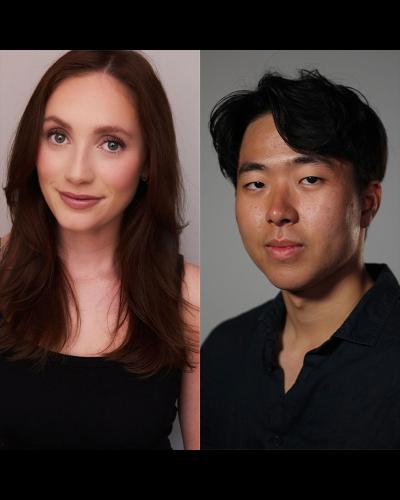
In this episode, new podcast co-host Emily Lee '27 and Christopher Christensen met with Cornell seniors Izzy Falchuk '26 and Justin Lee '26 to discuss the upcoming screening of their honors thesis films, “Undone” and “The Extraordinary Adventures of Ann Robinson”
Click HERE to see more episodes.
Transcript
00:00 Music
Chris Christensen 00:11
Hello and welcome to episode 71 of the PMA podcast. In this episode, new podcast co-host Emily Lee and I met with Cornell seniors Izzy Falchuk and Justin Lee to discuss the upcoming screening of their honors thesis films. Izzy's "Undone" and Justin's "The Extraordinary Adventures of Ann Robinson." Welcome to the podcast studio. Before we get into things, why don't you tell us a little bit about yourselves.
Izzy Falchuk 00:38
My name is Izzy Falchuk. I am from LA and I am a current senior at Cornell studying PMA.
Chris Christensen 00:47
Okay.
Justin Lee 00:48
My name is Justin Lee. I'm a senior in PMA with a minor in philosophy. I'm from South Korea and Canada, and it's a pleasure to be here.
Chris Christensen 01:00
I didn't know that you were a minor in philosophy.
Justin Lee 01:02
Used to be a major, but-
Chris Christensen 01:04
I was a major philosophy for a while too, and then I switched over to history. So, yeah.
Justin Lee 01:07
Did a little history too.
Chris Christensen 01:09
What, what, what before- I don't want to get too deep into it, because, you know, we've got all these great things to talk about in terms of your film project, but what, what made you change from a major to a minor?
Justin Lee 01:21
I did- I made the decision, like senior fall, and I just decided I wanted to just take more PMA classes.
Chris Christensen 01:28
Nice. You know what that kind of happens people, people come over here and they're like, yeah, yeah, I really enjoy PMA. Schwartz Center, kind of a home. What inspired you to create these particular stories that you're working on right now?
Izzy Falchuk 01:44
So the title of my film is Undone, and it follows a young woman who's rebuilding her life in New York after a very intense and devastating betrayal by her father in her childhood. And it kind of tries to answer the question of, who is this woman without her trauma, and it tells that story through her experience in therapy with her older, handsome therapist, Ethan, who she begins to transfer these obsessive romantic feelings onto but it becomes clear that those feelings are really just a reflection of the trauma she faced.
Chris Christensen 02:38
Okay, and where was the inspiration for that?
Izzy Falchuk 02:41
So I knew I wanted to make a thesis film. I really didn't know what I wanted it to be about. I think, like in my creative work, I tend to start with character. So I had this character in my head and this idea of trauma and what that means. And then I was sitting in my own therapy session this summer with this therapist that I hated. She was so annoying, and I was genuinely trying to think of anything to tune her out because I hated the sound of her voice. And I was like, hmm, like, therapy is such an interesting thing, because it really is a space that's like designed for vulnerability and for truth, but it doesn't always actually amount to that. And so I thought, what an interesting space to set a film and to set this particular character that I was already thinking about. And so it kind of came to be from that.
Chris Christensen 03:38
Okay. Thank you. Justin?
Justin Lee 03:43
Yeah, my film is called The Extraordinary Adventures of Ann Robinson, and it's a triptych, which means that there's kind of three separate and distinct stories that are kind of loosely connected thematically. So it's about this woman named Ann and her confrontation with the absurdity of the world and the absurdity of human existence, and then kind of coming to terms with that, and it's told in these three separate stories that are stylistically different. Each are their own genre, and each have their own tone and atmosphere. One is this absurdist comedy about having to act alongside a mannequin on a film set. Another is this surrealist body horror that kind of enters into her mind as her sense of self, figuratively and literally dissolves. And the final piece is kind of this shadow play fairy tale. Yeah, that that again, kind of forces her to confront what it is to live. And the inspiration for the whole thing started when I was reading Nausea by Jean-Paul Sartre. And I just really thought the imagery of the text would work perfectly in a in a visual form like film. And it was coincidentally when I was prep- preparing for my thesis. So that was the inspiration for the surrealist body horror section, and from that sprang these other parts of the triptych. The mannequin sequence, kind of sprang from my interest in theater of the absurd and the shadow play fairy tale thing, just kind of, yeah, I don't think there was an inspiration for that. It just kind of emerged from the other parts to complete the triptych.
Chris Christensen 05:33
Okay, I was, I was hoping there'd be something lining up with philosophy there. It sounded like you were going in that direction. So, yeah.
Emily Lee 05:42
So how long did the filming process take from pre-production to post-production?
Izzy Falchuk 05:49
I started writing my script in June, so I'd say everything started in June, and then we immediately started production when I got to school in September. So that was like finding locations and getting my crew together and finalizing my script and getting actors blah, blah, blah. So yeah, September, and then we're still in post-production now we're in the editing process. So a long time, all year, from like June to now.
Justin Lee 06:31
Yeah, just kind of echoing what she, she said, definitely a year-long process, just, yeah, the ideation process in June, and then pre-production in the fall and production slash post-production now. Yeah, it's been a pretty long, intense process.
Chris Christensen 06:48
How you both feeling as you're reaching the end of all of this? Does it feel sort of relieving to know that there that the films are almost done? Like, where are they at this point?
Izzy Falchuk 07:00
Yeah. Yeah. I mean, it's weird. It's like, I spent so much time and energy, like, my whole year, just like, so in this project that it's kind of like, weird that it's almost done. I personally am not editing my own film. No one would want to watch it if I edited it. I'm so, so terrible at that. So it's weird now that it's kind of out of my hands. Like, obviously I'm working with her, giving her notes, but it's like, at this point, I did everything I can do. So it's that's a weird feeling, but I'm excited.
Justin Lee 07:31
Yeah, for me, it's definitely like a sprint towards the finish line, getting the final cut made. But, yeah, like, as you said, it's just been so much energy dedicated towards this one singular thing that regardless of how it turns out, I think I'll feel fulfilled and pretty happy with it.
Chris Christensen 07:52
Okay, who were some of your mentors as you were working through this process?
Izzy Falchuk 07:58
Um, so definitely Jeff Palmer, my advisor. Really, really helped me throughout the whole thing. I knew I wanted him to be my advisor after working with him in Film One, I feel like he really has always believed in me and believed in the stories I want to tell, and like that's exactly what you want as a mentor and an advisor. So he's been so helpful along the way, with my script, and then with my production and any challenges I faced, and then also Aoise Stratford, who's my co-advisor, who I've also worked with in my playwriting and screenwriting classes, and who, again, just is so good at helping me really establish and deepen my thoughts and ideas about my story. And she's been so helpful. She got me all of my non-college age actors, so I worked with kids and adults, and she helped me get all of those, which was super helpful. And then definitely my dad, for sure, I feel like I can't not mention him. He does this for a living, and he really has been so helpful in everything from my script to like, I think that there are some things just like, as a young person and a young writer that like I don't even think of that he does so like having his guidance along the way was so helpful. And then even, like, I would call him before shooting and be like, oh my god, I'm so stressed, I don't know what I'm doing. And he would like, reassure me, which is so needed, especially when it's like I'm acting and directing and producing and doing all these crazy things. It was really helpful to have and like, bring me back down to earth.
Justin Lee 09:44
Yeah, for me, also Jeff Palmer, who is also my advisor, and just my filmmaking journey kind of started with him in Film One as a sophomore, and so I just kind of grew as a filmmaker with his guidance the entire way through. So to have him advise the thesis as well was a kind of full circle moment, and he's just, yeah, taught me. He's always kind of kept me grounded when I would get a little too ambitious. So I always appreciate keeping me realistic and pragmatic. But Jeff, for sure, David Feldshuh is also another advisor of mine on the thesis. He's just kind of been a seminal figure in what storytelling is for me, and so to have him help me with with the script and production of the film was huge. Aoise Stratford also, I took screenwriting with her last semester, so I got to work with her on the script a lot. Yeah, a master at her craft. Yeah, the script would not be where it is without her. And also, Beth Milles, who I'm taking Adaptation with right now, she's also just kind of more generally guided the way I see art and the way I see my art, and that's been huge during the production process of the film, too.
Chris Christensen 11:05
Okay, any of your peers who were mentors or supporters in any particular way?
Izzy Falchuk 11:10
Yeah, totally, I would say definitely. My two producers, who are also seniors here, Emma Alexander and Emma May, really helped me, like I really took on a lot logistically. I- we shot one weekend in New York City, and then one weekend here, going all over the place, so it was a lot to handle. And again, like I said, like, because I was acting and directing, there was so much creatively I had on my plate. So they really, really were lifesavers logistically. Again, like I would text them at like, three in the morning, being like, oh my god, I'm so stressed. We need to do this and this and this. And they would like just do it, which was so helpful. And then Liv Licursi, who recently graduated, was my first AD, and she was truly a lifesaver, like I genuinely could not have done this without her, like her organization and how, on top of things she was really made the whole process so smooth, but also so fun. Like, because we were so organized and so on top of it, because of her, we were able to, even though it was super difficult, logistically and emotionally and yada yada. Like, she made it so that we could all have fun on set and really just like, enjoy what we were doing, which is exactly how it's supposed to feel.
Chris Christensen 12:20
So nice.
Emily Lee 12:21
Do you guys have any like memorable moments or experiences from the filming process?
Justin Lee 12:27
The most memorable moment was definitely on one of our shoot days when it was a particular shot that was kind of top down, and I wanted both Zoe, who plays Ann Robinson her hands and feet to be in the frame, but just the way the camera was angled, it was impossible to have both. So we had her hands in the frame, and we needed, we needed a foot double. And so as director, I decided to just take one for the team, and I was the foot double.
Chris Christensen 13:02
You were the foot double.
Justin Lee 13:03
I was the foot double for Zoe in that particular shot. And it was a, I mean, it's funny, but it was also just kind of a moment of levity and a very stressful shooting day that I think everyone kind of remembers. So it was just, yeah, very actor, director moment being that foot double and yeah,
Chris Christensen 13:27
Things you never thought you'd do, even on the set of your own film.
Justin Lee 13:30
Exactly.
Izzy Falchuk 13:32
Can I add one more to my mentor thing?
Chris Christensen 13:35
Yeah.
Izzy Falchuk 13:36
Also my Co-DP's Angel Katthi and Jessie Jia, like really, were so instrumental in making the film. Again, I keep going back to this because I was acting and directing in this, like, really emotionally vulnerable state. They were so helpful in working together to make sure that both the emotional side of it and the visual side of it worked together, because I wasn't always standing behind the monitor like they really were so prepared and so on top of it, and so in tune with my story, which was so special to watch, like seeing how they could tell this story visually that I wrote was so amazing. So I definitely cannot forget to mention them.
Chris Christensen 14:22
Okay.
Izzy Falchuk 14:22
Um, and then, in terms of memorable moments on set, I feel like we had so many, like I said, it was logistically so insane. So we had six shooting days. The first day we shot at a restaurant here in Ithaca called Mercato in the commons. We rented out the whole restaurant. It, of course, was like the first week of daylight savings, and we started shooting at four, so we had to cover all the windows make it nighttime. And so that was fun, just to, like, be in the actual restaurant. And to, like, get everything good there, and have, like, our like, fake food, and I had to drink so much fake wine, which was grape juice, like I genuinely felt like I was gonna throw up after because I was, like, chugging the wine, like my character is supposed to be, like, super stressed and whatever, not feeling it. And I was chugging this grape juice. It was disgusting, but that was a great I feel like first start to our shoot, because it was really just like diving right in. And then we shot, Dr Sheppard was kind enough to let us use her office here in PMA as the therapist office. And that was so nice for our first weekend of shooting to like, have the home base that we're all so comfortable in, and like, be able to just, like, come to the Schwartz Center and like, have the green room be like, our green room like, so that was super nice and great to be able to settle in there. And then, of course, we went to New York City the next weekend, which so many fun memories there, I feel kind of bad. I like loaded every one of my crew, like 12 people into this, like white murder van at like 6am on that Saturday morning, and had them all drive to New York, drive directly to our location. They got out of the van, we started shooting. So it was, like, a lot, but, like, that's the business, so you gotta do but it was so fun. I think everyone was so excited to be there, which was so special for me to see, because I'm like, Oh my God, you're all here for me. Like, you're all so tired and getting up and schlepping five hours to New York City and like, to tell my story and like that was so, so amazing to see. And then we shot in this beautiful townhouse that I rented to be the therapist's house for the final scene, when my character shows up at his house, they have this big confrontation. That was super fun, just to all be there in this, like, beautiful place in New York City. So, yeah, so many more specific moments, but generally, like, it was so fun and just so amazing to see everyone come together and do such good professional work to tell my story.
Chris Christensen 17:15
Nice, any logistical problems that either of you ran into in the in the process of filming? I mean, you must have run into something. I mean, I love the idea that you didn't really anticipate what it was going to be like to have to drink that much grape juice.
Izzy Falchuk 17:30
Yes. I mean, there was definitely that for sure.
Chris Christensen 17:35
How about getting Mercato established as a filming location?
Izzy Falchuk 17:39
Yeah.
Chris Christensen 17:40
What were some of the things you had to go through to a stand?
Izzy Falchuk 17:42
So I knew immediately I wanted that space. I love that restaurant. I eat there all the time, and it's the whole thing. The whole film takes place in New York City. So I needed a restaurant here that felt like New York City. So I had said to everybody to like, all the PMA adults, and then my producers, was like, I need it to be Mercado like, period. And they're like, no. Like, no, no, I'm getting it. I'm getting it. And like, I am someone who, when I have I put my mind to something, I make it happen. So I emailed them, and I was like, hey, I want to shoot here. I don't know if you do this. I know they rent out the restaurant for private events, but I'm wondering if you would let me shoot then I set up a phone call with the manager, and she asked me a bunch of questions. She's like, I have to get back to the owners. It was, like, a two month long process. Good thing. I started really early. She's like, okay, the owner said maybe, but they want a contract to know exactly what you're doing. And I would get like, so panicked every time I would like, see her calling me, because I'm like, Oh my God, she's gonna say no. So my awesome producers wrote up a contract, they sent it back to her, and then finally, in like, I don't know, November, the owner, said yes, and that was amazing. So yeah, it was definitely a process, but I'm really glad that I followed through with it, and I didn't let anything like get me discouraged, and I didn't settle for anything less than I knew I wanted. And it ended up being so great. The manager was so amazing. She turned off all the, like, the fridges for us, so we didn't have, like, the buzzing in the background. So that was really amazing.
Chris Christensen 19:19
Wow.
Izzy Falchuk 19:20
Yeah.
Chris Christensen 19:20
Yeah.
Izzy Falchuk 19:20
Yeah.
Chris Christensen 19:21
Taking that extra step.
Izzy Falchuk 19:22
It was awesome.
Chris Christensen 19:23
Yeah. Sound wise, that's important.
Izzy Falchuk 19:24
Yes, very.
Chris Christensen 19:25
How about you Justin?
Justin Lee 19:27
Um, I guess, like a technical challenge I ran into is this, I had this idea for a shot where it's top down and it moves up and down vertically, looking at a paint can, and I just had no idea what kind of rip- rig would work to make this happen. And so I talked to Randy, Randy Hendrickson about it, and he just like, the next by the next day, came up with this rig that, just like, has these sandbag counterweights, and you just kind of like. It's just kind of like a pulley system that moves the camera up and down. And it was just, it was an incredible rig, and that just, yeah, helped me overcome that challenge of doing that shot. And so shout out, Randy. I should have mentioned him earlier. He's definitely also one of my mentors. And, yeah.
Chris Christensen 20:19
And where did you film?
Justin Lee 20:21
I was shooting mostly in the Schwartz. I shot one of my scenes in the Sound Stage, another in the Kip stage, and the third also in the Kip Stage. So, yeah, it was just all in the Schwartz.
Chris Christensen 20:35
So was there a set that was built or more of an ad hoc kind of setting things up as needed?
Justin Lee 20:42
Yeah, there was a kitchen set that was built in the soundstage for the mannequin sequence of the film.
Chris Christensen 20:48
Is that down in SB 23?
Justin Lee 20:50
Yes. And then in the Kip, this is the shadow play sequence. And so I needed a big kind of psych to have the shadow projected onto. And so they helped set up this really big, white, giant screen in the Kiplinger that I used for that part of the film.
Chris Christensen 21:10
Okay, and did you have any peers who were supportive of this whole endeavor?
Justin Lee 21:16
Yeah, I was just gonna shout out Katherine Lynn-Rose.
Chris Christensen 21:20
Oh, nice. Yeah, yeah yeah.
Justin Lee 21:21
Who graduated last year, but she was just always a resource during the pre production, production process, whenever I had any questions. And also just last year, working as a DP on her senior thesis, and just learning that way through seeing what she's doing, and just kind of trying to replicate that was just super helpful. So she's, she's definitely one of my bigger mentors.
Chris Christensen 21:46
Was she here in person at all during that time? Or just-
Justin Lee 21:49
No, just- kind of in spirit.
Chris Christensen 21:50
Zoom slash face time, slash, what have you.
Justin Lee 21:52
Yeah, just being available as a resource.
Chris Christensen 21:54
Okay, nice.
Emily Lee 21:56
Yeah. So how has your guys time in Cornell's PMA program shaped you as filmmakers and actors?
Izzy Falchuk 22:05
I think for me, PMA really taught me that I don't have to choose just one thing. I think I've always been someone who's loved acting, loved writing, loved directing and like, I just know that, like, I love those things and I can't choose one, but it's scary. Like, I feel like you get a lot of mixed messaging from the outside world being like, you have to choose this just one. You can't do it all. But I think being in PMA and like, being able to take all these, like, multi-disciplinary classes, and having the support from people like Jeff and Aoise and everyone being like, yeah, act in your own film like you should. I wasn't going to actually initially, but then they both read the script. My parents read the script, everyone the script. They're like, you gotta do this, which is a little mean. I'm just like a crazy girl. I'm like, thanks. I'm glad that's how you guys all see me. But I don't think I would have had the confidence or the foundation to do that without PMA, I think something that's so special about this program is like in our film classes, like we write our own script and direct our own script, and then in acting classes, we act, and then also direct, and then in directing classes, we direct and act. So it's really, I think, so helpful to have that foundation and like, basis of being able to do it all, and then especially the support too, is the most important. So I feel like, yeah, without PMA, I don't think I would have that foundation or confidence.
Justin Lee 23:42
I think the biggest way PMA kind of shaped me as a filmmaker and actor is just it's made me just a more collaborative person. I think looking back just at my earlier films, I kind of had a tendency to be very controlling over every part of the process, but through through PMA Studios, especially, I think I learned that. I learned the value of collaboration and the end product. The end product does end up being a lot better when it's an amalgamation of a lot of people's visions and ideas, rather than just a singular person. So I think this piece, kind of the culmination of everything I've done here has I tried to invite as much collaboration and input as possible during the ideation and production process, and I think I wouldn't have wanted to do that if it weren't for the experiences I had at PMA earlier. So.
Chris Christensen 24:38
What was the hardest part for you about having to give up that control was there some sort of like internal struggle, or anything like that, that you felt where you just when you finally let it go?
Justin Lee 24:52
Yeah, it's just as a director especially, you just want the film to match your vision. Perfectly, or at least that's what I originally thought. But you realize that your vision is, is not the end product. It's it's just a jumping off point for people to have their own, I guess, visions and ideas, and that's kind of the process of it all, rather than just starting with a vision and ending with a vision. And so once you realize that you can kind of relinquish that and and put it out there, for it to be changed and modified by others.
Chris Christensen 25:26
Has that influenced any other parts of your life? Academically, personally?
Justin Lee 25:35
I hope, I hope that that it's made me less stubborn and controlling in my day to day life as well, I guess. But who's to say?
Chris Christensen 25:48
How about you, Izzy, anything along those lines for yourself?
Izzy Falchuk 25:51
Yeah, definitely. I think that I am also, like very much, a person who likes to have control over everything. And I, like, I was saying, like, I have specific ideas, and I like them to happen, and I usually make them happen. But I think that obviously, with filmmaking at any level that you're doing it, like you have to be flexible. So, like, I really wanted this shot where the last scene of the film where Harper, the main character, and Ethan, the therapist, are sitting on like the step leading up to his townhouse, and the sun is setting. But obviously it's not realistic. It's like a six page scene, like we don't have enough time for the sun to set, and we don't have huge artificial lights. We're not on a sound stage, so I had to be flexible, and we moved the scene inside the house into the foray, and it actually ended up working so well, and it was beautiful, and this beautiful dark wood that they were sitting against, and it made it feel even moodier and like exactly what I wanted. So I think that that was just an example of something where I had to be flexible, and it ended up working really well. And I think too, like, again, acting and directing in this, I had to give up some control. Like, there were just things that I could not physically, like, mentally handle and control. So again, like, I would like, let Angel tell me this is not working. Like this on camera is not working. You got to change it. And that's hard for me to do, to like, listen to that and feel like I don't have control, but it was so helpful, and just made the film so so much better. So I think that I learned a lot about myself as an artist, as an actor, as a director, but also as a person of like sometimes you need to give up that control, and you need to be flexible, and you need to be able to change your plans, and it usually ends up being even better than you thought.
Chris Christensen 27:57
Okay, so along those lines, in terms of giving up the control, the one thing you have no control over is what your audiences experience. But what are you hoping that audiences will take away from the viewing of your films, from the experience?
Justin Lee 28:15
Yeah, it's a really abstract film. And so, like you said, I have so little control over what the audience actually gains from this, if anything at all. But my thesis when making the film was in response to the question of, I guess, just Why live? It's to embrace the brief, ephemeral moments of beauty and human connection in our day to day lives, rather than pursuing some more abstract sense of purpose or life or life goal. That was the thesis I had when I made the film, and so I hope audiences get any semblance of that when they're watching it, which I don't know that they will, given how kind of far out it is, but that's the hope.
Chris Christensen 29:10
Okay, how about you Izzy?
Izzy Falchuk 29:13
I think for me, it's interesting, like our films are so contrasting, which I think is so cool, because mine is so grounded in reality and in, like the really real, raw human experience. So I think that I my main takeaway is that trauma does not define you, and that you can rewrite your own story, and you can kind of take ownership of who you are, and take that control back from the people or things or experiences that took it from you. And I want people to leave feeling reflective. I feel like the ending is pretty open and just the material throughout is like a lot. Like it's very intense and very emotionally intimate and vulnerable. So I want people to use that to reflect on their own lives and their own experiences and the way that they express their emotions and their truths. And I really hope that I did the work to make them have that moment of reflection, or moments of reflection after they watch. And I hope that people leave, although it is not a happy film, I hope they leave feeling a little bit of hope and feeling like this character we see went through this journey, and definitely, although small, like had this shift in her mind and in her being. And I hope that that makes my audience feel hopeful that they too, can change and can shift and can start feeling better.
Emily Lee 31:11
So kind of like going through this whole process, what advice would you give to other student filmmakers who are working on their own projects?
Justin Lee 31:21
I think a big thing I learned throughout this entire process is not to be too precious with what you're doing, which sounds kind of contradictory, but I think earlier on in the process, even more recently, I just always kind of got in my head about the scale and the importance of what I'm doing, and like, oh, this might be my last chance to make a film with this amount of resources. It has to be perfect. It has to be exactly what I need it to be, or it's a failure. There was no in between. It had to be perfect or it had to be a failure. But I think throughout the process now, I've come to realize that just if I learn one, one thing from this experience, it will be a success. It doesn't the end product of the film, ultimately does not matter as much as the process I took to get there. And so I hope the end product is good. That would be a good kind of side plus. But ultimately, the I think the big lesson I'd love to share with everyone else is that the film doesn't need to be perfect. You don't need to be perfect. All you have to do is just learn something from the process.
Izzy Falchuk 32:37
That's great advice I'm gonna take that. It's like, it's hard to remember that that that, but it's very, very true and very good advice. So definitely take that. I think I would say, Just do it like, don't, let anyone tell you you can't, and believe in yourself. Obviously, I had so much support from everyone, but I did come in proposing this, like, super ambitious project, of like, getting students to New York City and shooting there and housing them and whatever. So, of course, understandably, there was pushback. Of like, Can you do it here? And can you compromise? But I really stuck by my thought that I was not going to compromise. So I think obviously, in the most polite and good way, you can stand by what you want and what you believe will work, and what you believe is the best thing for your film, and just do it like work really, really hard, and be organized and have all your ducks in a row. But don't let anyone tell you you can't. In the film world, in every world, everyone's gonna tell you you can't. And so I think my advice would be, after completing this and doing it successfully, to don't like, don't listen, just do it. Just know what you want, know exactly what you want, know what exactly what your vision is, and get to work. And do it. Yeah,
Chris Christensen 34:15
So not only are your films almost at the point in which they're going to screen, your peers are going to see them. Faculty are going to see them. All these people are going to see them. Family. You're also approaching the end of your time at Cornell, which is probably very hard to believe, four years goes by really quickly. What's lined up next for both of you, post Cornell?
Justin Lee 34:37
I'm going to USC to pursue an MFA in acting, which is slightly different from stuff I've been doing here, but it's just an area of my craft that I really want to expand upon. And I love the program there and I'm looking to get to stay warm in April, so I thought that was a perfect move for me to be next.
Chris Christensen 35:00
Yeah, warm, not like here in central New York.
Izzy Falchuk 35:07
I am going to go to New York City next year and kind of take the year to like, live. I feel like, as an artist, you have to do that. I'm someone who likes a lot of control and structure, but I think that letting myself just have a year of freedom to, like, do stupid films and work with my friends and write and not have the structure that I've always given to myself will be really, really beneficial. And then I'm going to apply, probably, to film schools next year for the year after, but I definitely wanted a year of not being in school.
Chris Christensen 35:46
Okay, you said, to use your words. You said you're gonna do some stupid films. I can't imagine that's true. What are some of the- do you have some ideas for projects you're gonna work on?
Izzy Falchuk 35:56
So many, I mean, so many of my own ideas. I feel like any artist listening to this can relate, like you are always thinking about the next thing to do and the next story to write. So I'm super excited for that. I definitely want to work with other people in collaborating, writing scripts or acting in their films, or directing their films, like I said, like I love this kind of multidisciplinary thing that has become so much more normalized. So I'm really excited to dive into that and to just kind of have the freedom to do everything I want to do.
Chris Christensen 36:32
Nice. One question I love asking, because sometimes people just don't know, when are the films actually screening. And what date and time? Do you know all that information?
Izzy Falchuk 36:44
I know it's May 7.
Justin Lee 36:46
Yeah, Thursday, May 7, 5pm I believe.
Chris Christensen 36:49
You win. Yes, you both win. Yes, yes. I don't know what the grand prize is, but you get it. Yes, in the Kiplinger Theatre. Anything we didn't ask you today that you would love to talk about, or, Emily, did you have other questions?
Emily Lee 37:03
No, not really.
Chris Christensen 37:04
Okay. Well, we both thank you very much for being on the podcast, and look forward to seeing your films when they screen very, very soon, and best of luck in the final stages with all the editing and post production.
Justin Lee 37:19
Thank you.
Izzy Falchuk 37:20
Thank you.
Justin Lee 37:20
Thank you for having us.
Izzy Falchuk 37:21
Yeah, it was super fun.