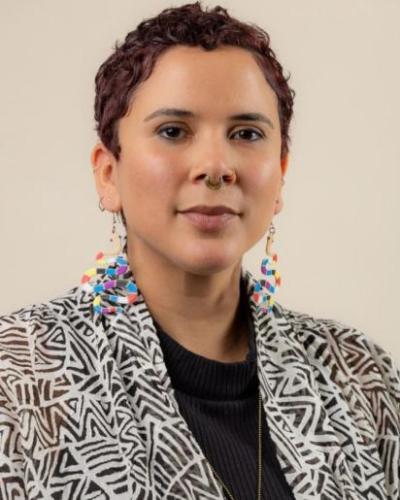
PMA Ph.D. Candidate Gina Goico has published an article called “Reveliones Fugitivas: Unveiling Indigenous, Afro-Indigenous and Black rebellions through art in Santo Domingo's colonial city" in Performance Research Journal’s Issue 7: On Ghosts. “This article,” says Goico, “examines how artistic interventions in Santo Domingo's colonial city (La Zona) produce a site of increased refusal between historical memory and national identity, revealing the ghosts of Afro-Indigenous and Black rebellions.”
Read our interview with Goico:
What brought you to this project and what do you hope readers will take away?
Reveliones (with an italicized 'v') are central to my dissertation project, which examines how the productions of self-identified Black Dominican artists and activists challenge state-circulated identity in the Dominican Republic and its New York City diaspora. As someone who existed as an artist and activist in the Dominican Republic for years before migrating, this project is deeply personal; I am turning to the strategies and productions of my peers and comrades, people whose work I witnessed and participated in, as spaces where theory is enacted.
The performances and aesthetics of these artists and activists are what I term “reveliones”, a wordplay between revelar (to reveal) in Spanish and rebelión (rebellion). These simultaneously expose the oppressive nature of state-circulated identity and rebel against it, while also revealing a queering of identity. In this article, an early version of what is now the first chapter of my dissertation, I propose the term “Reveliones Fugitivas,” building on the work of Indigenous and decolonial scholars Jarrett Martineau and Eric Ritskes, who propose “fugitivity” as a set of camouflaged practices that reveal their meaning in motion. I extend this concept to Black and Afro-Indigenous practices in the DR and its diasporas as a decolonial tool.
A clear example of this is the work of artists and activists operating within La Zona Colonial (Santo Domingo's colonial city), where the preservation of colonial architecture ties in to colonial power, becoming the stage for spectral acts of resistance. Reveliones fugitivas emerges as both a theoretical framework and a survival strategy in these spaces, creating possibilities for generational change through acts that reveal the contradictions embedded within Dominican national identity. My hope is that readers leave with an understanding that these are not isolated artistic gestures; they are part of a longer, ongoing rebellion.
What was your approach in crafting this publication?
As this is an earlier version of one of my dissertation chapters, I approached it as an exercise in exploring the spectral nature of reveliones. I specifically thought, what happens when reveliones are enacted in historically charged places like La Zona Colonial? What happens when the artist or activist also functions as a "medium"? What if we envision reveliones as a séance, where the act of revealing does not simply uncover the past but calls it forward, where the artist stands at the threshold between the colonial archive and the living present, and the Afro-Indigenous and Black resistance haunting those stones and streets?
That image stayed with me throughout the writing. How does coloniality continue to operate within these spaces, and how do artists and activists move through it, around it, and against it? These questions allowed me to expand this chapter into the realm of spectrality and ghosts for the special issue, and I think the séance framework gives readers a way to feel the stakes of what is happening in these performances and analyze them.
What would you like readers to know about your work?
My dissertation examines the Dominican Republic and its diasporas as a transnational space in which colonial and imperial legacies shape identity; in it I analyze literary works, performative actions, and artworks, as well as organizing strategies, as acts of refusal and a queering across these geographies and sites. I want readers to understand that these registers, the artistic, the scholarly, and the activist, are continuously informing one another, and my work tries to honor that.
Part of that commitment takes the form of “2000s Resistencias,” a digital archive for social movements in the Dominican Republic, which I am currently developing with support from a Caribbean Research Travel Grant from Cornell LACS, which will later be housed within El Museo de la Resistencia in the DR. I also want readers to understand why this is urgent. My project demonstrates how morality determines who counts as human and who deserves citizenship, and how, even within these conditions, resistance exists and becomes central to reaffirming one's belonging and identity. The artists and activists I write about are doing this work now, under active surveillance and risk, and my scholarship thinks alongside them. Understanding these dynamics amid intensified far-right violence makes this inquiry pressing for the Caribbean and Latin America, and I argue that it also illuminates how similar mechanisms of exclusion and surveillance operate in the US context.
Read the full article here.
Read more about Gina Goico.